Stop Guessing What to Improve
in Your Digital Business.
Learn a structured way to identify what's limiting performance, decide what deserves attention next, and measure whether the change actually worked.
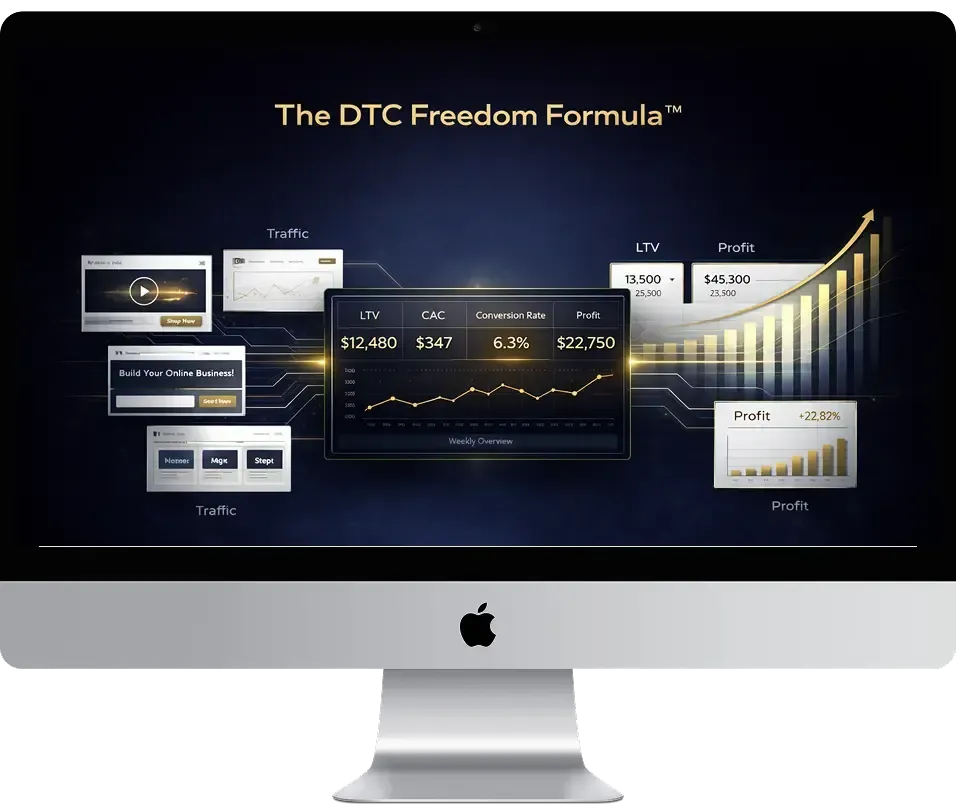
The DTC Freedom Formula™ gives you the operating methodology, frameworks, and practical tools to make better-informed decisions about what to improve next.
Less scattered optimization. More clarity, confidence, and control.
Please watch this short message before continuing.
There Are Two Types of Digital Entrepreneurs Right Now


The first type is doing everything they're "supposed" to do. They work hard, test new channels, tweak creative, change offers, rebuild funnels — and then panic when performance dips. Their business isn't actually being operated. It's being reacted to.


The second type runs their digital product like a professional Direct-to-Consumer (DTC) business. They understand what matters economically, they know how to identify the real constraint, and they execute with a disciplined cadence. Their decisions compound instead of restarting every week.
The difference between these two types isn't intelligence or effort. It's their operating system. And the longer you run without the right one, the more of your finite time you spend in motion without momentum.
If you're here, you're probably not chasing hype. You're looking for the operating system that makes the business feel stable.
The Problem Isn't Your Product. It's Operating Without a System.
Most digital entrepreneurs aren't failing because their product is weak, or because the market is saturated, or because they "don't know marketing."
They're failing because they are making decisions without a system — and no amount of effort compensates for that.
You feel it as inconsistent revenue. You feel it as the anxiety of not knowing whether to scale or hold. You feel it as the exhaustion of checking dashboards and still not knowing what to do next.
That's what creates the familiar loop: you see performance swings, you feel uncertainty, you make a change, you watch a metric move, you make another change. It looks like progress, but it's mostly motion — because the decisions aren't anchored to economic truth.

What Operating Without a System Looks Like (And Why It's Exhausting)

It looks like not trusting your ad decisions because the metrics feel overwhelming. It looks like scaling too early — or refusing to scale at all — because you can't see the guardrails.
It looks like chasing tactics because you don't have a methodology for what to fix first.
And it often feels like being "almost there," while stability stays just out of reach.
If you're like most serious builders, you're probably:
Lying awake at 2 AM wondering if you're optimizing the right thing — or just moving deck chairs on the Titanic
Checking dashboards compulsively, hoping the numbers will tell you what to do next
Feeling like an impostor when people ask "how's business?" — because you honestly don't know if you're succeeding or just getting lucky
Working harder than ever while watching others with worse products build more stable businesses
Starting each week with a new strategy, only to abandon it when the first metric dips
And the worst part?
You're not failing because you're lazy or incompetent. You're failing because you're operating without economic precision.
Every day you continue this way:
Your confidence erodes a little more
The gap between you and disciplined operators widens
Your business feels more like a burden than an asset
The real enemy isn't competition.
It's economic decision-making without precision.
The Secret to Calm Execution
There's a reason some builders look calm while everyone else looks frantic. They aren't smarter. They aren't luckier. They aren't working harder.
They are operating from clarity. They know how to interpret the business economically, how to identify the constraint that actually matters, and how to move with cadence instead of chaos.
That is the exact shift the DTC Freedom Formula™ is designed to install. And I know how powerful this shift is, because I spent 20 years living it.

Why I Care About This (And Why "Corporate Success" Isn't The Goal)

I spent over 20 years building and scaling Direct-to-Consumer businesses at the highest level.
From 2006 to 2013, I worked for the number one DRTV company in Japan. During that time, we grew from $200M to over $500M in sales, selling multiple products on TV and spending over $10M monthly on advertising. I worked closely with company executives and managed multiple divisions.
Later, I was recruited by a US-based fast-moving consumer goods company as their DTC Marketing Director, tasked with building their DTC operations in Japan from scratch. Shortly after, I was promoted to Country Manager. We took the business from zero to $7M in 18 months, and eventually scaled it to over $15M annually.
From the outside, it looked like the ultimate path: responsibility, scope, success.
But there was a paradox baked into it. No matter how well I executed, I was building someone else's asset without personal control.

When Corporate Logic Destroyed a Profitable DTC Machine
Then came the moment that made it impossible to unsee.
After our company was acquired, new leadership stepped in. Despite our DTC division generating over 20% profit on our media spend, we were ordered to cut advertising globally to protect short-term corporate earnings.
Then came a decision that confirmed the people in charge didn't understand DTC economics: I was forced to list our DTC-exclusive product on Amazon. I warned them it would cannibalize our DTC sales and reduce media efficiency.
It happened exactly as predicted. Amazon sales tripled, but our highly profitable DTC sales collapsed. Media was cut. Inventory piled up. For 15 months, my team and I managed the consequences of decisions made by someone who didn't understand the business model.
That's when I realized something profound: You can build a $15 million business... and still not control the outcome.
Corporate success does not equal personal control.
INCLUDED WITH YOUR OFFER

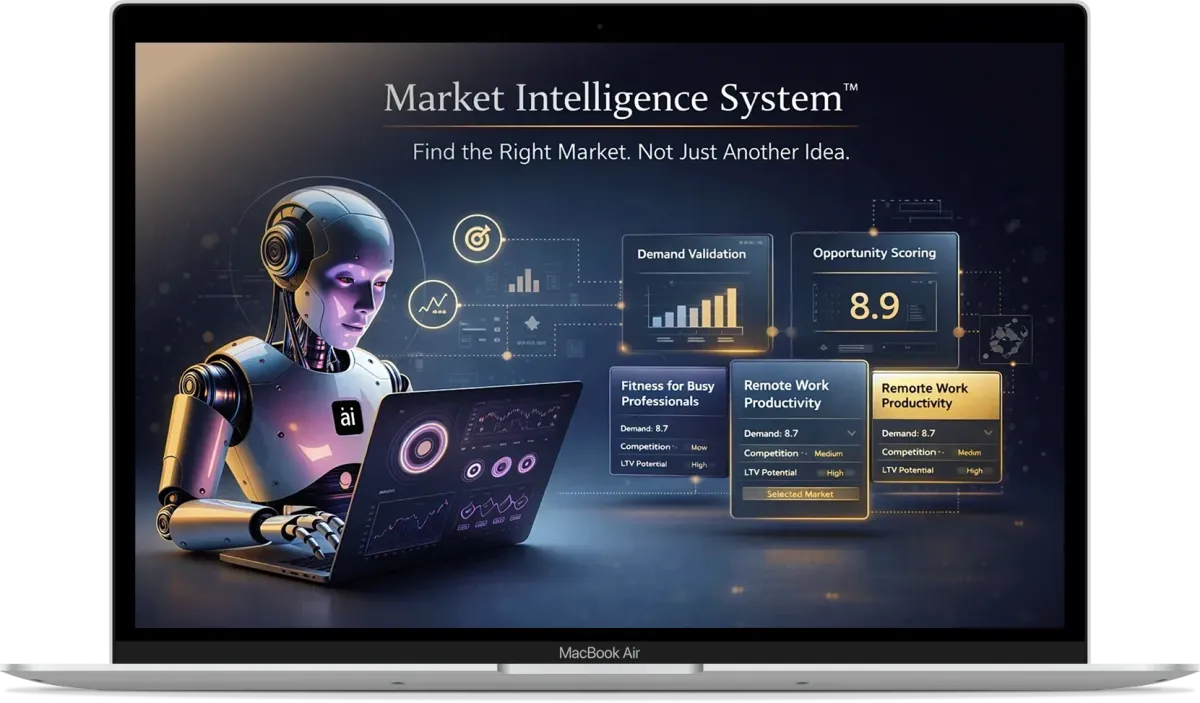
Market Intelligence System™
Learn how to use AI-supported demand validation, competitive mapping, and opportunity scoring to choose markets that support long-term customer relationships.
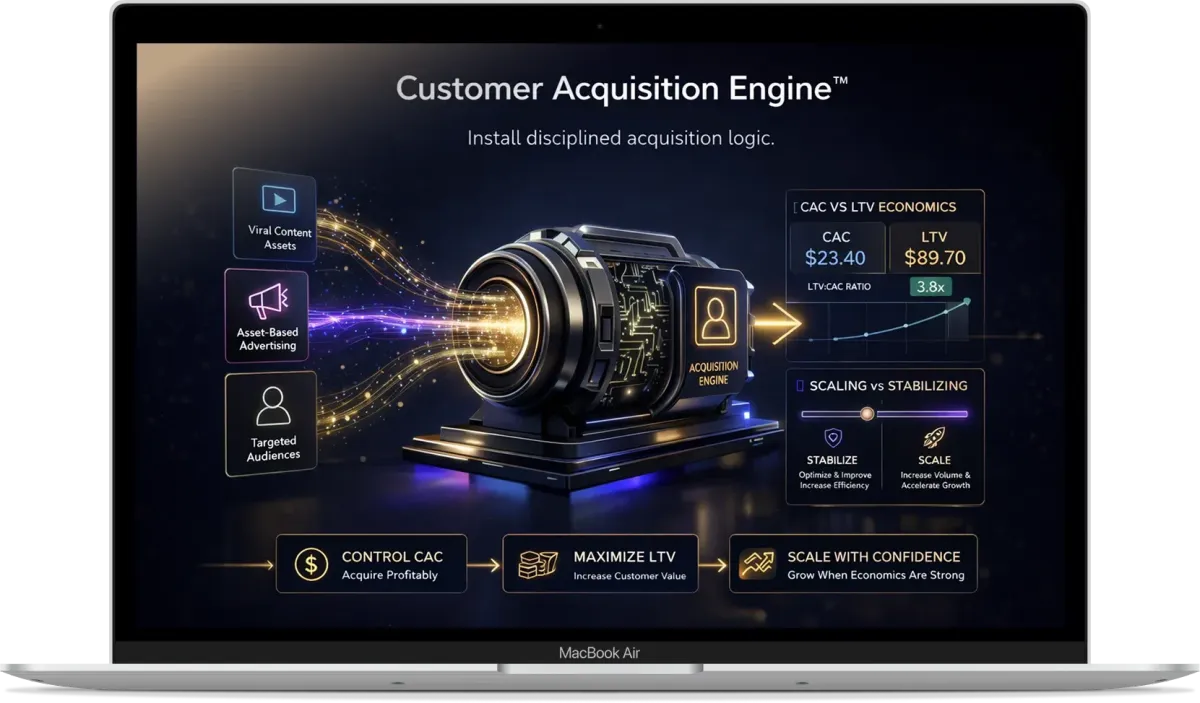
Customer Acquisition Engine™
Understand Customer Acquisition Cost (CAC) vs LTV economics, asset-based advertising, and exactly when to scale versus when to stabilize.
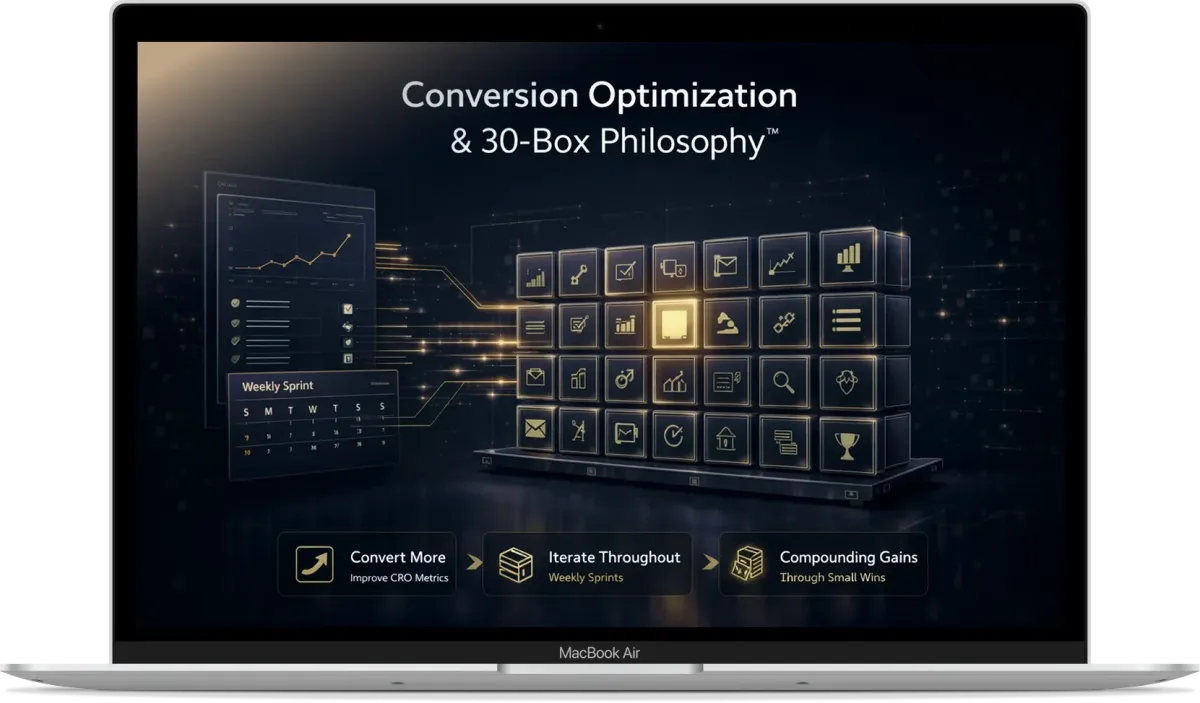
Conversion Optimization & 30-Box Philosophy™
Identify your true bottlenecks and apply the 30-Box Philosophy to compound small improvements through a disciplined weekly cadence.
The 24-Hour Decision That Changed Everything
After two years of corporate downsizing, I accepted a voluntary buyout. I was relieved.
But then the recruiters started calling. One opportunity stood out: a senior executive role at a global TV home shopping company. It was perfectly aligned with my 20 years of experience. The compensation was double my previous salary.
I had 24 hours to decide.
I thought about my mother, who had passed away after seven years of Alzheimer's. I thought about my father, who is 93. I thought about my wife's family in Japan, and my desire to split our time between Japan and Canada.
During COVID, I had seen something clearly: if you work on a computer, you can work from anywhere. Corporate life doesn't guarantee that freedom.
Even with double the income, going back didn't excite me. Freedom did.
The next morning, I called the recruiter and declined.
The Discovery: The "Done-For-You" Illusion

When I first entered the digital product space, I thought I could just apply my DTC operator skills to other people's products. I tried the standard paths everyone recommends.
First, I bought digital product libraries. The content was flimsy. Then, I bought "done-for-you" funnel templates. They were disjointed.
Finally, I paid $5,000 for a reseller license to a "proven" digital course. I spent two months reformatting it just to meet my own quality standards.
When I finally ran ads, the results were middling. I looked at the numbers and saw the problem immediately: my CPM was over $200. I was competing against five other people selling the exact same product with the exact same landing page. The FEP, the order bumps, and the upsells had no logical ascension flow. It was a recipe for "overpromised and underdelivered."
That's when I realized: a lot of digital entrepreneurs are trying to build DTC businesses, but they are relying on creator tactics and copy-paste funnels instead of operating systems.
I knew I had to build something based on my actual 20 years of DTC experience. That's when the DTC Freedom Formula™ was born.

The DTC Freedom Formula™
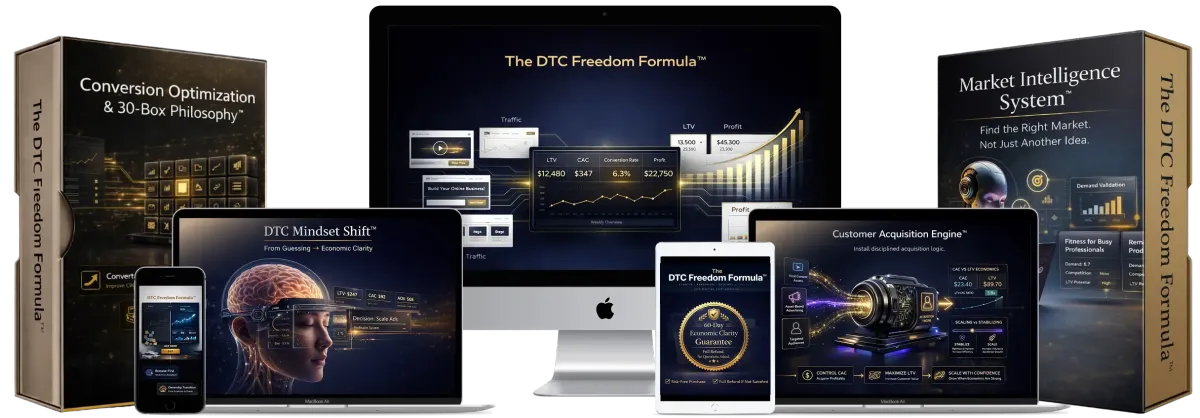
This is not a bundle of tactics. It is the operating system shift from creator thinking to operator precision.
The DTC Freedom Formula™ installs a professional, data-driven operating system behind your digital product. It teaches you how to operate like a real Direct-to-Consumer company, focusing on data to optimize business performance and profitability.
The Unique Mechanism:
The 30-Box Performance Philosophy™
The Unique Mechanism: The 30-Box Performance Philosophy™
Most digital businesses don't suffer from a lack of things they could improve. The challenge is knowing which improvement deserves attention first.
Traffic. Conversion. Pricing. Offers. Customer Acquisition. Retention. There is always another metric, tactic, or idea competing for your attention.
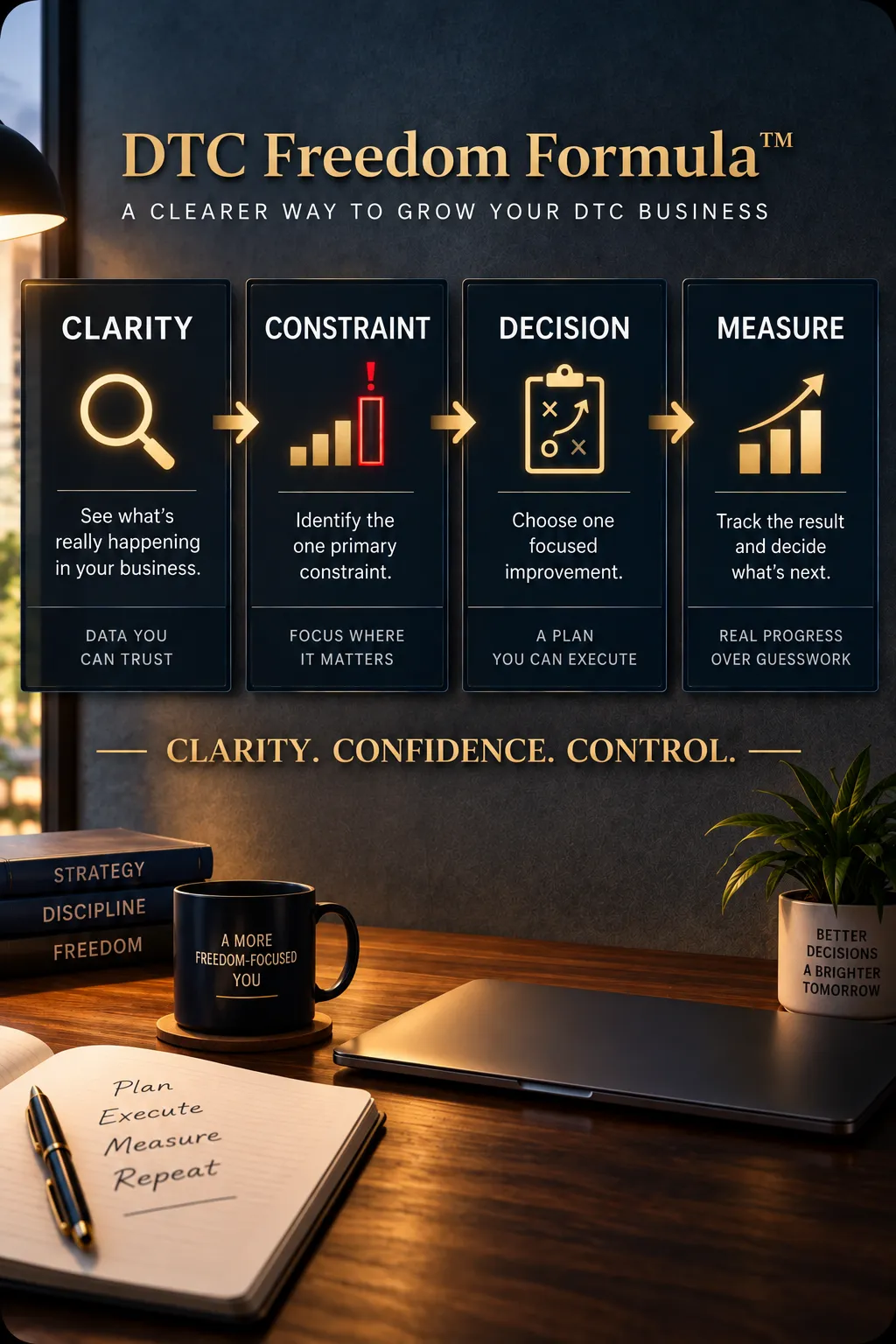
The 30-Box Performance Philosophy™ gives you a structured way to identify the constraint that matters most, focus improvement there, and measure the result before deciding what comes next.
The DTC Freedom Formula™ gives you a disciplined process to:
Evaluate performance systematically instead of reacting to individual metrics
Identify the primary constraint limiting performance
Prioritize one high-leverage improvement at a time
Measure whether the change actually improved performance
Use what you learn to decide what deserves your attention next
Install Now For Only $17!
Install The DTC Freedom Formula™ For Just $17
Bonuses Will Be Delivered Instantly.
Get Full Access Right Away.

🔒100% Secure 256-Bit Security Encryption

The 6-Module Operating System
Six modules take you from scattered optimization to a structured way of operating your digital business.
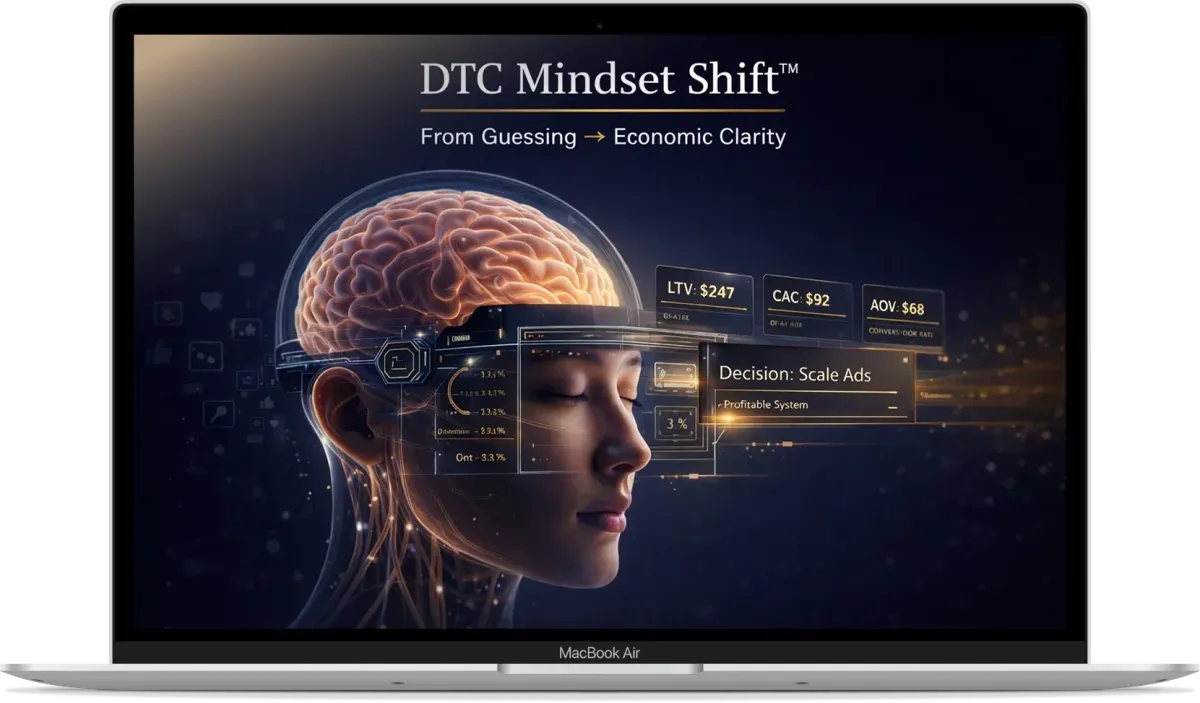
Module 1:
DTC Mindset Shift™
Stop thinking like a creator and start operating like a DTC business owner. Learn to make data-centric decisions, treat ads as an asset, and shift from first-sale thinking to Lifetime Value (LTV) thinking.
Module 2:
Market Intelligence System™
Remove the guesswork. Learn how to use AI-supported demand validation, competitive mapping, and opportunity scoring to choose markets that support long-term customer relationships.
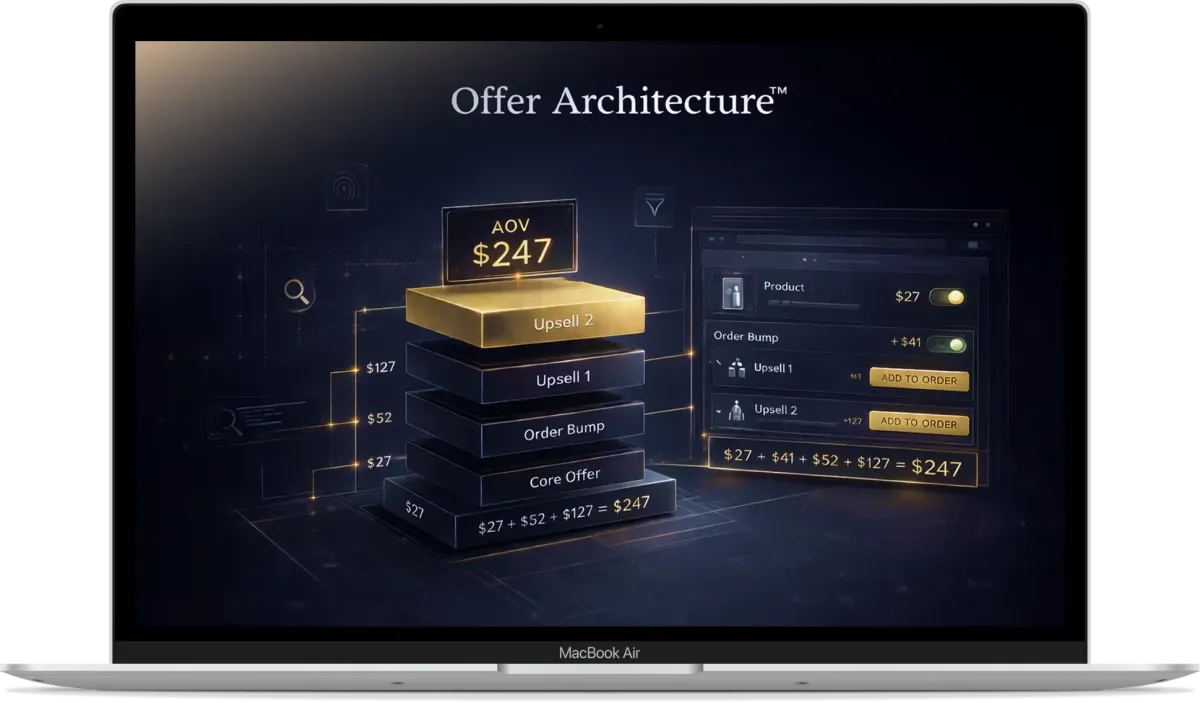
Module 3:
Offer Architecture™
Build economically viable offers using DTC psychology. Master offer stacking, Average Order Value (AOV) strategy, order bump logic, and upsell positioning.
Module 4:
Customer Acquisition Engine™
Install disciplined acquisition logic. Understand Customer Acquisition Cost (CAC) vs LTV economics, asset-based advertising, and exactly when to scale versus when to stabilize.
Module 5:
Conversion Optimization & 30-Box Philosophy™
Learn leverage thinking. Identify your true bottlenecks and apply the 30-Box Philosophy to compound small improvements through a disciplined weekly cadence.
Module 6:
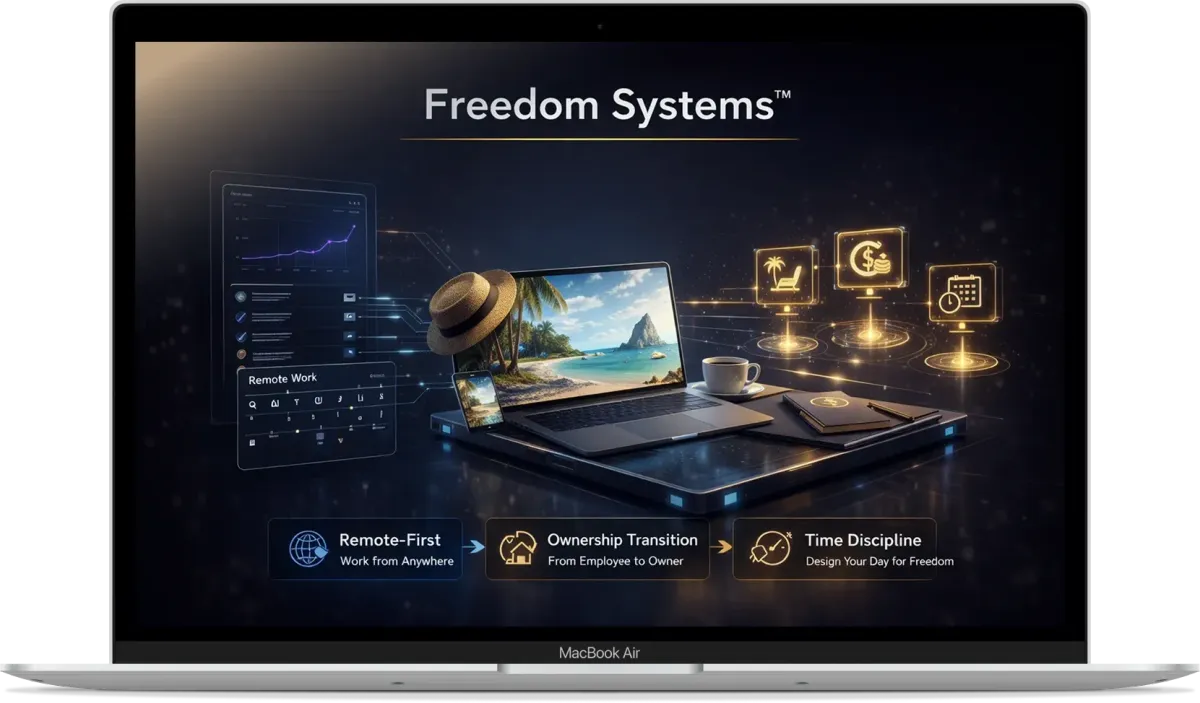
Freedom Systems™
Connect disciplined economics to life design. Structure a remote-first business, manage the corporate-to-ownership transition, and build the time discipline required for true freedom.
Everything You Need to Start Operating Differently
The DTC Freedom Formula™ gives you the methodology, frameworks, and practical tools to move from scattered optimization to structured decision-making.

CONTENT
WHAT IT HELPS YOU DO
DTC Freedom Formula™ — 6 Module Framework
Build a structured operating system for making better-informed decisions across your digital business.
25 Implementation Resources
Practical tools, templates and frameworks to help you apply and implement the methodology from each module.
Corporate DTC Operator Mindset Playbook™
Shift from corporate thinking to an operator mindset built around ownership, iteration, outcomes and data-driven decisions.
Market Intelligence Shortcut System™
Extract actionable customer and competitor insights from four practical research sources to strengthen your messaging & positioning.
High-Conversion Offer Diagnostic Framework™
Diagnose the specific element limiting offer conversion so you can focus on the highest-leverage improvement.
LTV-Based Scaling & Optimization Playbook™
Use customer lifetime value to guide smarter scaling, optimization and customer-acquisition decisions.
The DTC Optimization Decision Engine™
Identify your primary constraint, prioritize the right improvement and execute a disciplined weekly optimization process.
Why High Performers Leave Corporate™
Explore the shift from corporate success toward greater ownership, time leverage and control through DTC entrepreneurship.
What You Get
DTC Freedom Formula™ — 6 Module Framework ---
Build a structured operating system for making better-informed decisions across your digital business.
25 Implementation Resources Apply and implement the methodology from each module with practical tools, templates and frameworks.
Corporate DTC Operator Mindset Playbook™ ---
Shift from corporate thinking to an operator mindset built around ownership, iteration, outcomes and data-driven decisions.
Market Intelligence Shortcut System™ ---
Extract actionable customer and competitor insights from four practical research sources to strengthen your messaging and positioning.
High-Conversion Offer Diagnostic Framework™ ---
Diagnose the specific element limiting offer conversion so you can focus on the highest-leverage improvement.
LTV-Based Scaling & Optimization Playbook™ ---
Use customer lifetime value to guide smarter scaling, optimization and customer-acquisition decisions.
The DTC Optimization Decision Engine™ ---
Identify your primary constraint, prioritize the right improvement and execute a disciplined weekly optimization process.
Why High Performers Leave Corporate™ ---
Explore the shift from corporate success toward greater ownership, time leverage and control through DTC entrepreneurship.
Who This Is For
This operating system is designed for people who want a more structured way to
build and improve a digital business:
The Active Digital Creator:
You've made sales, but you can't stabilize your revenue because the economics feel unclear and inconsistent.
The Corporate Professional Building an Exit:
You are competent, experienced, and used to structured systems. You are feeling the ceiling or burnout and want a responsible, data-driven transition.
The Serious Beginner:
You haven't launched yet, but you are researching deeply. You are overwhelmed by tactics and want to build correctly from day one.
Who this is NOT for
This is NOT for you if you're looking for a shortcut, a "done-for-you" get-rich-quick scheme, or a way to make money without building a real business. The DTC Freedom Formula™ is for people willing to implement a structured operating system and make disciplined, better-informed decisions about what to improve next. If that's not you, this isn't the right fit — and that's okay.
Why the DTC Freedom Formula™ Is $17
The DTC Freedom Formula™ is priced at $17 deliberately.
Our goal is to remove price as the reason a serious digital business owner doesn't install a more structured way to evaluate and improve performance.
The value of the Formula isn't determined by its price. It comes from how you apply the methodology — identifying what matters, focusing on the right constraint, and making better-informed decisions about your business.
$17 gives you access to the complete operating system so you can start applying it to your business immediately.
Our "Economic Clarity or It's Free" Guarantee
Try the DTC Freedom Formula™ for 60 days.
Install the operating system.
Work through the DTC Freedom Formula™ and put the 30-Box Performance Philosophy™ into practice. Use the frameworks and resources to identify what deserves your attention, make better-informed decisions, and bring greater structure to the way you operate your digital business.
If you're not satisfied for any reason, simply email us within 60 days of your purchase and we'll refund your payment.
No questions asked. No hoops to jump through.
Just email [email protected] and we'll process your refund within 48 hours.
Put the system to work. Decide for yourself whether it helps you make clearer, more structured decisions about what to improve next.
One-Time Payment • Instant Access • 60-Day Money-Back Guarantee

The Truth About "Closing Windows"
You've probably seen marketers use urgency to suggest that the "window of opportunity is closing" or that you need to act before the market becomes too saturated.
That's not the premise behind DTC Freedom.
The opportunity to build and improve a digital business isn't disappearing because of an arbitrary deadline.
What matters is whether you have a structured operating system for identifying what deserves attention, making better-informed decisions, and measuring whether those decisions actually improved performance.
There is no artificial deadline here.
If the DTC Freedom Formula™ gives you the operating structure you've been looking for, you can get started today for $17.
If it doesn't, don't buy it.
The objective isn't to make a rushed decision. It's to make an informed one.
Frequently Asked Questions
Q: Who is this for?
A: Structured builders in transition: active creators with inconsistent revenue, corporate professionals building an exit, and serious beginners who want to build correctly from day one.
Q: I'm in my late 50s. Is it too late to build something like this?
A: Absolutely not. I just turned 58. Years ago, I visited a good friend at his beautiful home in Fountain Hills, Arizona. He was a high school dropout who built a highly successful business from scratch — but his real success didn't accelerate until his mid-50s. That conversation was the primary reason I decided to choose freedom and entrepreneurialism over continuing my corporate life. There is no expiration date on building something for yourself. The only question is whether you want to start with the right operating system.
Q: Is this another tactics course?
A: No. The DTC Freedom Formula™ is not built around a collection of tactics or the latest marketing trends. It gives you a structured operating methodology for evaluating performance, identifying the constraint that deserves attention, deciding what to improve next, and measuring whether the change actually worked. Tactics may change. The decision-making discipline behind the system is designed to remain useful as your business evolves.
Q: I’m already working 60+ hours a week. Honestly, do I have time to implement this?
A: The DTC Freedom Formula™ isn't about adding more to your plate; it's about replacing scattered firefighting with a more structured operating cadence. Instead of trying to improve everything at once, you'll learn to identify what deserves attention, focus on the highest-leverage constraint, and make one targeted improvement at a time. The goal is to help you use your available time more deliberately — not create another list of tasks to manage.
Q: I'm overwhelmed by metrics — will this help?
A: Yes. The goal is economic clarity and decision confidence — not more dashboards. The 30-Box Performance Philosophy simplifies what you look at so you only focus on the highest-leverage metrics.
Q: Is this just theory, or will I get practical frameworks I can use immediately?
A: No. This is a practical methodology built from the operating principles I've used throughout my DTC career. You'll get frameworks including the 30-Box Performance Philosophy™, Constraint Leverage Identification process, and LTV-Based Decision Architecture — supported by practical resources designed to help you apply the methodology to your own business.
Q: I've taken other business courses. How is this different?
A: Most courses teach tactics. This installs an operating system. Tactics change; operating systems compound. You're not getting "10 ways to optimize your funnel" — you're getting the economic precision framework that tells you which optimization matters most and why. It's the difference between learning chess moves and learning chess strategy.
Q: Is there a community or Q&A access, or is this purely self-paced?
A: Yes. The Formula is self-paced, so you can work through the methodology on your own schedule. You’ll also receive access to the private DTC Freedom Community™, where you can ask questions, engage with other members, and continue the discussion as you apply what you’re learning.
The Transformation You're Buying
Before, revenue feels inconsistent. Ad decisions feel emotional. Metrics feel overwhelming. Scaling feels risky.
After, you have clearer economic understanding. You can make data-driven decisions with greater confidence. You have a systematic way to prioritize what matters. And you build a stronger foundation for profitable decision-making.
That's the promise: not excitement — economic precision.
What Operating With Precision Actually Looks Like


Imagine it's Monday morning.
Instead of anxiety about which metric to check first, you open your dashboard as part of a disciplined weekly cadence.
You immediately see your constraint: people are clicking your ads, but too few are converting once they reach the landing page.
Your landing page conversion rate is the lever that needs attention.
You know where to focus. You know what to improve. And you know exactly how you'll measure whether it worked.
You spend 60-90 minutes making the week's key decisions — not because you're rushing, but because you operate on cadence, not chaos.
By early afternoon, you’ve implemented the optimization action.
You record the daily KPI numbers for the week and then measure the result during your Weekly DTC Operator Review.
By next Monday, you’re making the next disciplined decision
This is what operating with economic precision feels like.
And you can install the DTC Freedom Formula™ for $17.
One-Time Payment • Instant Access • 60-Day Money-Back Guarantee
Choose How You Want to Operate
Continue Without a Structured System

Continue evaluating performance as you do today:
Review metrics individually
Decide what to improve based on immediate problems
Optimize multiple areas as priorities change
Rely on experience and judgement to determine what comes next
Install a Structured Operating System

Use the DTC Freedom Formula methodology to:
Evaluate performance systematically
Identify the constraint limiting performance
Prioritize one high-leverage improvement
Measure the result before deciding what comes next